AI adoption and student productivity in higher education
A cross-institutional study
DOI:
https://doi.org/10.32674/2wda3n83Keywords:
ChatGPT, Generative AI, Higher Education, Student Productivity, Behavioral Intention, UTAUT, Academic Integrity, Cross-Institutional StudyAbstract
This cross-institutional study investigates the impact of generative AI, specifically ChatGPT, on student productivity and behavioral intentions in higher education, comparing responses from Texas College (USA) and Kathmandu Model College (Nepal). Grounded in the Unified Theory of Acceptance and Use of Technology (UTAUT) framework, this research explores how readiness, frequency of use, and perceptions of productivity influence students’ intentions to continue using AI. Data were collected from 507 undergraduate students across higher education institutions in the United States and Nepal and analyzed using descriptive statistics, reliability testing, and ordinal logistic regression. Results indicate that frequent AI users perceive higher academic productivity, while institutional affiliation had no significant effect. Readiness and perceived productivity emerged as strong predictors of continued AI use; however, some students expressed uncertainty about ethical and academic integrity concerns.
References
Adiguzel, T., Kaya, M. H., & Cansu, F. K. (2023). Revolutionizing education with AI: Exploring the transformative potential of ChatGPT. Contemporary Educational Technology, 15(3), ep429. https://doi.org/10.30935/cedtech/13152
Alam, M. A., Pratama, G., & Kumar, R. (2023). AI in education: Applications, challenges, and future trends. Computers & Education, 188, 104676. https://doi.org/10.1016/j.compedu.2023.104676
Aoun, J. E. (2017). Robot-Proof: Higher Education in the Age of Artificial Intelligence. MIT Press.
Bin-Nashwan, S. A., Sadallah, M., & Bouteraa, M. (2023). Use of ChatGPT in academia: Academic integrity hangs in the balance. Technology in Society, 75, 102370.
Common Sense Media. (2023). Parents and students are optimistic about AI, but parents have a lot to learn to catch up to their kids—and want rules and ratings to help them. https://www.commonsensemedia.org/research/parents-and-students-are-optimistic-about-ai-but-parents-have-a-lot-to-learn-to-catch-up-to-their-kids-and-want-rules-and-ratings-to-help-them
Creswell, J.W., & Creswell, J.D. (2018). Research design: Qualitative, quantitative, and mixed methods approaches. Sage, Los Angeles.
Dabingaya, M. (2022). Analyzing the Effectiveness of AI-Powered Adaptive Learning Platforms in Mathematics Education. Interdisciplinary Journal Papier Human Review, 3(1), 1-7. https://doi.org/10.47667/ijphr.v3i1.226
Dwivedi, Y. K., Hughes, L., Baabdullah, A. M., & Ribeiro-Navarrete, S. (2023). Metaverse, artificial intelligence, and extended reality in education. International Journal of Information Management, 68, 102676. https://doi.org/10.1016/j.ijinfomgt.2022.102676
Gamlem, S. M., McGrane, J., Brandmo, C., Moltudal, S., Sun, S. Z., & Hopfenbeck, T. N. (2025). Exploring pre-service teachers’ attitudes and experiences with generative AI: A mixed methods study in Norwegian teacher education. Educational Psychology. https://doi.org/10.1080/01443410.2025.2528663
Hamamra, B., Khlaif, Z. N., Mayaleh, A., & Abu Baker, A. (2025). A phenomenological examination of educators’ experiences with AI integration in Palestinian higher education. Cogent Education, 12(1). https://doi.org/10.1080/2331186X.2025.2526435
Holmes, W., Bialik, M., & Fadel, C. (2021). Artificial Intelligence in Education: Promises and Implications for Teaching and Learning. Routledge.
Hwang, G. J., Xie, H., Wah, B. W., & Gašević, D. (2020). Trends and research issues of AI in education: A review of journal publications from 2000 to 2019. Interactive Learning Environments, 29(1), 1–19. https://doi.org/10.1080/10494820.2020.1815813
Kaplan-Rakowski, R., Grotewold, K., Hartwick, P., & Papin, K. (2023). Generative AI and teachers’ perspectives on its implementation in education. Journal of Interactive Learning Research, 34(2), 313-338.
Kohnke, L., Moorhouse, B. L., & Zou, D. (2023). Exploring generative artificial intelligence preparedness among university language instructors: A case study. Language Teaching Research. https://doi.org/10.1177/13621688231209143
Konca, A. S., Simsar, A., Alhajji, R., & Al Mansoori, A. (2025). Cross-cultural perspectives on AI adoption in teacher education: A comparative study of pre-service teachers in Turkey and the United Arab Emirates. Interactive Learning Environments. https://doi.org/10.1080/10494820.2025.2488143
Luckin, R. (2018). Machine Learning and Human Intelligence: The Future of Education for the 21st Century. UCL Press.
Luo, Q. Z., & Hsiao-Chin, L. Y. (2023). The Influence of AI-Powered Adaptive Learning Platforms on Student Performance in Chinese Classrooms. Journal of Education, 6(3), 1–12. https://doi.org/10.53819/81018102t4181
Mochizuki, Y., Bruillard, E., & Bryan, A. (2025). The ethics of AI or techno-solutionism? UNESCO’s policy guidance on AI in education. British Journal of Sociology of Education. https://doi.org/10.1080/01425692.2025.2502808
OpenAI. (2023). ChatGPT: Optimizing language models for dialogue. https://openai.com/blog/chatgpt
OpenAI. (2024). OpenAI unveils ChatGPT Edu to bring AI responsibly to university campuses. https://openai.com/blog/chatgpt-edu
Ravšelj, D., Keržič, D., Tomaževič, N., Umek, L., & Brezovar, N. (2025). Higher education students' perceptions of ChatGPT: A global study of early reactions. PLOS ONE. https://doi.org/10.1371/journal.pone.0255678
Ruiz-Rojas, A., De la Peña-Esteban, F., de la Fuente-Arroyo, M., & Criado, A. M. (2023). Empowering education with generative AI: Instructional design matrices and the 4PADAFE framework. Computers & Education: Artificial Intelligence, 4, 100118. https://doi.org/10.1016/j.caeai.2023.100118
Sari, H. E., Tumanggor, B., & Efron, D. (2024). Improving educational outcomes through adaptive learning systems using ai. International Transactions on Artificial Intelligence, 3(1), 21-31.
Selwyn, N. (2019). Should Robots Replace Teachers? AI and the Future of Education. Polity Press.
Sharkey, J. (2025, March 7). AI cheating surges at universities: Scottish institutions have been warned they must keep pace with the technology after it was revealed only two use software to detect its misuse. The Times. https://www.thetimes.co.uk/article/ai-cheating-surges-at-universities-5vktqdsvj
Sharples, M. (2025). A systems approach to AI and education in a post-digital world. Theory Into Practice. https://doi.org/10.1080/00405841.2025.2528549
Tang, G. (2023). Academic journals cannot simply require authors to declare that they used ChatGPT. Irish Journal of Medical Science. https://doi.org/10.1007/s11845-023-03374-x
Tang, X., Yuan, Z., & Qu, S. (2025). Factors Influencing University Students' Behavioural Intention to Use Generative Artificial Intelligence for Educational Purposes Based on a Revised UTAUT2 Model. Journal of Computer Assisted Learning, 41(1), e13105.
Teo, T. (2019). Students and teachers’ intention to use technology: Assessing their role using the UTAUT framework. Educational Technology & Society, 22(4), 74–86.
The Times. (2025). AI cheating surges at universities. https://www.thetimes.co.uk/article/ai-cheating-surges-at-universities-5vktqdsvj
UNESCO. (2023). Guidance for generative AI in education and research. United Nations Educational, Scientific and Cultural Organization. https://unesdoc.unesco.org/ark:/48223/pf0000386693
Valle, N. N., Kilat, R. V., Lim, J., General, E., Cruz, J. D., Colina, S. J., ... & Valle, L. (2024). Modeling learners' behavioral intention toward using artificial intelligence in education. Social Sciences & Humanities Open, 10, 101167.
Venkatesh, V., Morris, M. G., Davis, G. B., & Davis, F. D. (2003). User acceptance of information technology: Toward a unified view. MIS Quarterly, 27(3), 425–478. https://doi.org/10.2307/30036540
Williamson, B., & Eynon, R. (2020). AI in education: A critical review. Learning, Media and Technology, 45(1), 1-14. https://doi.org/10.1080/17439884.2020.1686010
Zapata, G. C., Cope, B., Kalantzis, M., Tzirides, A. O., Saini, A. K., & Searsmith, D. (2025). AI and peer reviews in higher education: Students’ multimodal views on benefits, differences and limitations. Technology, Pedagogy and Education. https://doi.org/10.1080/1475939X.2025.2480807
Zawacki-Richter, O., Marín, V. I., Bond, M., & Gouverneur, F. (2019). Systematic review of research on artificial intelligence applications in higher education. International Journal of Educational Technology in Higher Education, 16, 39. https://doi.org/10.1186/s41239-019-0171-0
Additional Files
Published
Issue
Section
License
Copyright (c) 2026 American Journal of STEM Education

This work is licensed under a Creative Commons Attribution 4.0 International License.
Copyright (c) [year] [author]
This work is licensed under a Creative Commons Attribution 4.0 International License.
This license permits unrestricted use, distribution, and reproduction in any medium, provided the original author and source are credited. https://creativecommons.org/licenses/by/4.0
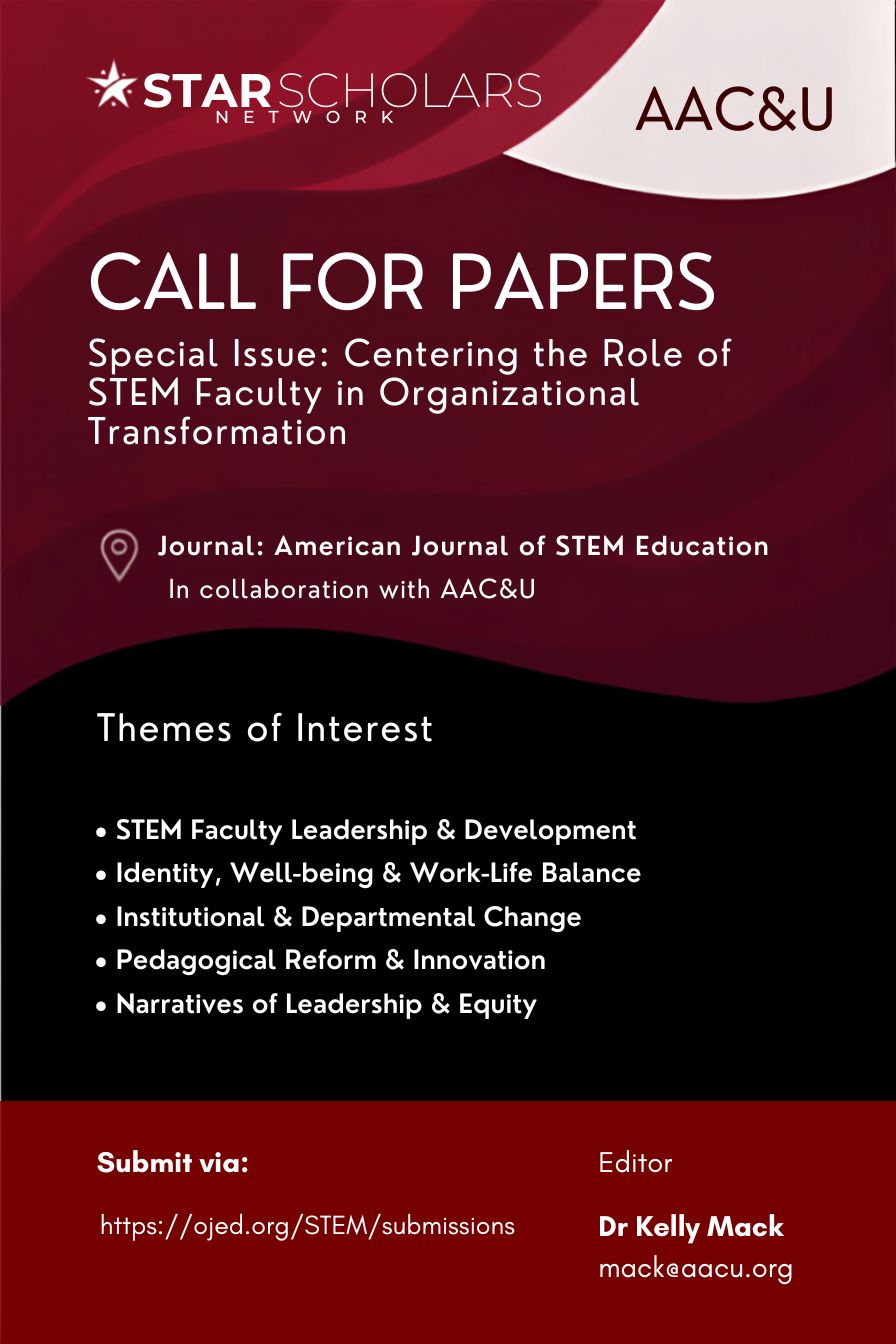
 Call for Special Issue Proposals